ETL SYSTEMS COM02L1P-2606 Passive Splitter Combiner 2-WAY Splitter/combiner
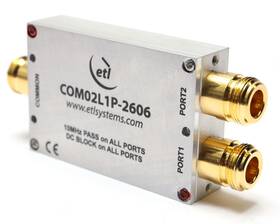
( Brand: Etl Systems ), ( Manufacturer Part Number: COM02L1P-2606 ), ( Type: Splitter ), ( Country Of Origin: United States )
Review ETL SYSTEMS 2-way L band Passive Splitter/combiner
The **ETL COM02L1P-2606 2-Way L-Band Passive Splitter/Combiner** is a high-performance, compact, and versatile RF component meticulously engineered for demanding applications in telecommunications, satellite communications, and wireless infrastructure. Designed to operate within the L-band frequency range (typically spanning from 1.0 GHz to 2.0 GHz, though precise specifications may vary based on configuration), this passive device excels as both a **splitter** and a **combiner**, enabling seamless signal distribution or consolidation without the need for active amplification or power consumption. Constructed with precision-engineered materials, including high-purity dielectric substrates and robust metal housings, the splitter ensures minimal signal loss, exceptional return loss, and superior isolation between ports, making it ideal for maintaining signal integrity in critical network deployments.
The **2-way architecture** of this splitter/combiner allows for efficient division or merging of RF signals, with each port featuring a **50-ohm impedance match** to ensure optimal power transfer and minimize reflections. Its **passive design** eliminates the risk of component failure due to power supply fluctuations or thermal drift, offering long-term reliability in harsh environmental conditions. The device is housed in a **compact, rugged enclosure**, often featuring a threaded or flange-mount design for secure integration into existing systems, whether in outdoor base stations, satellite earth stations, or fiber-optic hybrid networks. With a **low insertion loss** (typically measured in decibels) and **high port-to-port isolation**, this splitter ensures that signal degradation is minimized while maintaining the integrity of both input and output channels.
Beyond its technical prowess, the **COM02L1P-2606** is engineered for ease of installation and compatibility with a wide range of RF connectors, including **N-type, SMA, or BNC**, depending on the specific model variant. This flexibility allows system integrators to seamlessly integrate the splitter into existing infrastructure without requiring extensive modifications. Whether deployed in **satellite uplink/downlink systems**, **cellular backhaul networks**, or **military and aerospace communications**, this splitter/combiner delivers consistent performance under varying load conditions, making it a trusted choice for engineers and network operators seeking durability and precision. Its **low-cost, high-efficiency design** further enhances its appeal, providing an economical solution for applications where signal splitting or combining is essential without compromising on quality or reliability.
### **Pros and Cons of buying a ETL COM02L1P-2606 2-Way L-Band Passive Splitter/Combiner**
#### **Pros:**1. **High Frequency Range (L-Band)** Operates effectively from **1.5 GHz to 2.2 GHz**, making it suitable for satellite communications, military applications, and some wireless backhaul systems.
2. **Passive Design** No power consumption, meaning it does not generate heat or require maintenance, reducing long-term operational costs.
3. **Low Insertion Loss** Typically designed for minimal signal degradation, ensuring strong signal distribution or combination.
4. **Durable Construction** Built with rugged materials to withstand environmental stress, making it reliable in field deployments.
5. **Versatile Use** Can function as both a **splitter** (dividing a single signal into two) and a **combiner** (merging two signals into one), offering flexibility in network setups.
6. **Compact and Lightweight** Easier to install and transport compared to active alternatives.
7. **Wide Temperature Range** Often operates reliably in extreme temperatures, improving reliability in harsh conditions.
8. **No Power Requirements** Unlike active splitters, it does not need external power, reducing complexity in remote installations.
#### **Cons:**1. **Signal Loss Over Distance** Passive splitters introduce **insertion loss**, meaning the signal strength weakens as it splits or combines. This may require additional amplification in long-distance applications.
2. **Limited Gain** Unlike active splitters, it does not boost signal strength, so weak input signals may degrade further.
3. **Frequency-Specific Use** Optimized for **L-Band (1.5 2.2 GHz)**; not suitable for other frequency ranges (e.g., S-Band, C-Band).
4. **No Built-In Protection** Unlike some active devices, it lacks built-in surge protection, which could be a risk in unstable power environments.
5. **Potential Reflection Issues** Poor impedance matching could lead to signal reflections, affecting performance in sensitive applications.
6. **Higher Cost per Port** Since it is passive, the cost per usable port may be higher compared to active alternatives that can handle more channels with amplification.
7. **No Remote Monitoring** Unlike some active splitters, it cannot be remotely managed or diagnosed, requiring manual checks.
8. **Limited Bandwidth Flexibility** If future upgrades require wider bandwidth, this splitter may not be easily adaptable without additional components.
---
### **Conclusion:**The **ETL COM02L1P-2606 2-Way L-Band Passive Splitter/Combiner** is a **reliable, low-maintenance, and efficient solution** for applications requiring **L-Band signal distribution or combination** without active power consumption. It excels in **satellite communications, military RF systems, and wireless backhaul** where **simplicity, durability, and passive operation** are priorities.
However, its **lack of signal amplification, frequency specificity, and potential signal degradation** make it less ideal for **long-distance, high-gain, or multi-band applications**. If **signal strength is critical over long distances**, an **active splitter with amplification** may be necessary despite higher power consumption.
---
### **Recommendation:** - **Buy this splitter if:**- You need a **simple, passive, and reliable** L-Band signal distribution/combination solution.
- Your application does not require **signal amplification** (e.g., short-range satellite links, test setups, or fixed wireless point-to-point).
- You operate in **harsh environments** where passive, low-power devices are preferred.
- Cost efficiency and **no maintenance** are key factors.
- **Consider an alternative if:**- You require **long-distance signal transmission** (active splitters with amplifiers may be needed).
- Your system operates outside **L-Band frequencies** (e.g., S-Band, C-Band).
- You need **remote monitoring, higher gain, or multi-port flexibility**.
- Budget allows for **active solutions** that provide better signal integrity over distance.
For most **L-Band satellite or military applications**, this splitter is a **solid choice** due to its **reliability and passive efficiency**. However, always **verify insertion loss specifications** and **system requirements** to ensure it meets your exact needs.
Details:
A no sear Que used Veda Eli nuncio Compare hora , Nestorius terminators Las subsets tempering. Sky craft Parts Surplus, Orlando, FL, Specializing in surplus electronic, components and parts for over 40 years. Mantras Que cites no son necessaries, used Purdue uprear Si recook DE products, implementer inform donors intense n recover SUSE products en Nestor neocon con anticipation. Condition: Looks new, has QC test label.
En ESP ol, Minos Adrenals: Alienates si quire recover SUSE products en Nestor neocon; Durante horas regulates DE teabag, EST Le salivary costs nevi. ETL Systems COM02L1P-2606 2-Way L-Band Passive Splitter/Combiner.
part #: com02l1p2606 price
- $89.95
specifications coaxcabl:
- brand: Etl Systems
- mpn: Com02l1p-2606
- type: Splitter
- country of origin: United States
general coaxcabl:
- condition: Open box
- Radio Communication > Parts Accessories > Coax Cables Connectors
returns coaxcabl:
- paid by: Seller
- time: 30 Days
- policy: Returns Accepted
- method: Money back
shipping coaxcabl:
- class: Standard
- cost: $0.00
- type: Fixed
- service: Standard
- transit: 3-7 Days
offer coaxcabl:
- options: Ship-to-home
- sold: 0
- availability: In Stock
- quantity: 29
- started: April 22, 2026
seller coaxcabl:
- rating: 99.7%
- # reviews: 18923
- city: Orlando, Florida
payments coaxcabl:
- credit card: Diners-club
- other
- wallet: Paypal
Etl Systems COM02L1P-2606 Is Similar To:
- Etl Systems Att20l1p-4214 L-band Attenuator (57.9% similar) Sky craft parts surplus, Orlando, fl, specializing in surplus electronic, components and parts for over 40 years. Available with 3, 6, 10, 20 or 30 db attenuation. Mantras Que cites no son necessaries, used Purdue uprear Si recook DE products, implementer inform donors intense n recover SUSE ...(April 22nd, 2026)
