GLENAIR 947-433 Coaxial Hermetically Steel Feedthru
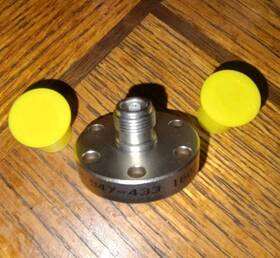
( Brand: Glenair ), ( Manufacturer Part Number: 947-433 ), ( Type: Coaxial Feedthru ), ( Connector B: Female )
Review GLENAIR Coaxial Hermetically Sealed Stainless Steel Feedthru
The **Glenair 947-433 Coaxial Hermetically Sealed Steel Feedthrough** is a precision-engineered component designed for high-reliability applications where signal integrity and environmental protection are paramount. This rugged feedthrough is crafted from high-grade stainless steel, ensuring exceptional durability and resistance to corrosion, making it ideal for use in harsh industrial, aerospace, or military environments where exposure to moisture, chemicals, or extreme temperatures could compromise performance. The hermetically sealed design guarantees a vacuum-tight or gas-filled enclosure, preventing contamination and maintaining signal purity by eliminating air gaps or moisture ingress that could degrade coaxial cable performance over time. With a robust **Type N (PL-259) male connector** on one end and a **female coaxial interface** on the other, this feedthrough facilitates seamless integration into RF systems, antennas, or sensor assemblies where signals must traverse sealed chambers without degradation.
The **947-433** is engineered to handle high-frequency signals with minimal loss, thanks to its precision-machined center conductor and high-purity dielectric, which ensures consistent impedance and low return loss across a wide frequency spectrum. Its **steel housing** provides structural integrity while resisting thermal expansion, making it suitable for applications involving temperature fluctuations, such as satellite communications, radar systems, or medical imaging equipment. The feedthrough s **flanged mounting design** allows for secure and repeatable installation, reducing the risk of misalignment or signal leakage that could occur with less robust alternatives. Additionally, its **low outgassing properties** make it well-suited for vacuum-sealed environments, such as those found in space-based or laboratory instrumentation, where residual gases could interfere with sensitive measurements.
For engineers and technicians working in mission-critical applications, the **Glenair 947-433** offers a balance of performance, reliability, and ease of integration. Its **military-grade construction** adheres to strict quality standards, ensuring long-term performance even under demanding conditions. Whether used in defense electronics, scientific research, or industrial automation, this feedthrough provides a dependable solution for maintaining signal integrity while protecting internal components from external contaminants. With its combination of hermetic sealing, high-frequency compatibility, and robust mechanical design, the **947-433** is a versatile choice for professionals who demand nothing less than excellence in their RF and signal transmission systems.
The Glenair 947-433 is a hermetically sealed coaxial feedthrough designed for applications requiring high reliability in sealed environments, such as vacuum chambers, cryogenic systems, or high-pressure enclosures. Below is a detailed breakdown of its pros and cons, followed by a conclusion and recommendation.
---
### **Pros of the Glenair 947-433 Coaxial Feedthrough**
1. **Hermetic Sealing**
The feedthrough is designed to maintain a vacuum or sealed environment, preventing gas leakage or contamination. This is critical for applications like semiconductor manufacturing, particle accelerators, or space simulation chambers where even trace amounts of air or moisture can degrade performance.
2. **High Reliability and Durability**
Glenair components are known for their robust construction, often used in mission-critical industries such as aerospace, defense, and medical equipment. The stainless steel housing and precision seals ensure long-term performance under extreme conditions.
3. **Wide Frequency Range**
The coaxial design supports high-frequency signals (typically up to several GHz, depending on specifications), making it suitable for RF, microwave, or high-speed data applications. This versatility is valuable for testing or operational environments where signal integrity is paramount.
4. **Compatibility with Extreme Environments**
The feedthrough can operate in a broad range of temperatures (often from cryogenic to high-temperature extremes) and pressures, depending on the specific model and application. This adaptability is useful in cryogenic systems, vacuum chambers, or high-pressure testing setups.
5. **Low Outgassing**
Hermetic feedthroughs are designed to minimize outgassing, which is essential in ultra-high-vacuum (UHV) applications where residual gases can interfere with experiments or equipment performance.
6. **Customization Options**
Glenair offers various configurations, including different connector types (e.g., SMA, N-type, or custom), flange sizes, and materials to match specific application requirements. This flexibility allows for integration into diverse systems.
7. **Regulatory and Industry Standards Compliance**
Glenair products often meet or exceed industry standards such as MIL-SPEC, NASA, or ISO, ensuring compatibility with stringent quality and safety requirements in regulated industries.
---
### **Cons of the Glenair 947-433 Coaxial Feedthrough**
1. **High Cost**
Hermetic feedthroughs, especially those from reputable manufacturers like Glenair, are significantly more expensive than standard coaxial connectors or non-sealed alternatives. The cost reflects the precision engineering, materials, and testing required to ensure hermeticity.
2. **Complex Installation and Maintenance**
Installing a hermetic feedthrough often requires specialized tools, techniques, and expertise to ensure proper sealing. Improper installation can compromise the hermeticity, leading to leaks or failures. Maintenance may also be more involved compared to standard connectors.
3. **Limited Availability of Spare Parts**
Due to the specialized nature of hermetic feedthroughs, finding replacement parts or compatible components can be challenging. This may result in longer downtimes if a component fails.
4. **Size and Weight Constraints**
Hermetic feedthroughs are typically bulkier and heavier than standard coaxial connectors. This can be a limitation in space-constrained applications or where weight is a critical factor (e.g., aerospace or portable equipment).
5. **Potential for Signal Loss or Distortion**
While coaxial feedthroughs are designed for high-frequency applications, improper installation or aging seals can introduce signal loss, reflections, or distortion. This requires careful selection and testing to mitigate issues.
6. **Long Lead Times**
Due to their specialized nature, Glenair feedthroughs may have longer lead times compared to off-the-shelf components. This can impact project timelines, especially in time-sensitive applications.
7. **Compatibility Issues with Non-Standard Systems**
If the application requires non-standard connector types or flange sizes, customization may be necessary, adding to the cost and complexity. Ensuring compatibility with existing systems can be a hurdle.
---
### **Conclusion**
The Glenair 947-433 coaxial feedthrough is an excellent choice for applications where maintaining a sealed environment is non-negotiable, such as in vacuum chambers, cryogenic systems, or high-reliability RF/microwave setups. Its hermetic sealing, durability, and compatibility with extreme conditions make it a trusted component in industries like aerospace, defense, and scientific research. However, the high cost, complexity of installation, and potential limitations in size or signal integrity must be carefully considered.
For applications where hermeticity is not required or where cost and simplicity are prioritized, standard coaxial connectors or non-sealed alternatives may be more practical. Conversely, if the application demands a sealed environment and the feedthrough s advantages outweigh its drawbacks, the Glenair 947-433 is a reliable and high-performance solution.
---
### **Recommendation**
Purchase the Glenair 947-433 if:- Your application requires a hermetically sealed environment (e.g., vacuum, cryogenic, or high-pressure systems).
- Signal integrity and reliability are critical, and you can justify the higher cost.
- You have access to the expertise or resources needed for proper installation and maintenance.
- Customization or compliance with strict industry standards (e.g., MIL-SPEC) is necessary.
Avoid or consider alternatives if:- The application does not require hermeticity, and cost or simplicity is a higher priority.
- The system has space or weight constraints that make the feedthrough impractical.
- You lack the technical expertise to install or maintain the feedthrough properly.
- Lead times or availability of spare parts are a concern for your project timeline.
For smaller-scale or less critical applications, evaluate whether a standard coaxial connector with a vacuum sealant or gasket could suffice. Always conduct a cost-benefit analysis to ensure the feedthrough aligns with your project s requirements and budget.
Details:
Glenair 947-433 Coaxial Hermetically Sealed Stainless Steel Feedthru.
part #: 947433 price
- $74.50
specifications coaxcabl:
- brand: Glenair
- mpn: 947-433
- type: Coaxial Feedthru
- connector b: Female
general coaxcabl:
- Radio Communication > Parts Accessories > Coax Cables Connectors
- condition: New
seller coaxcabl:
- city: Richland, Washington
- rating: 99.6%
- # reviews: 1262
returns coaxcabl:
- policy: No Returns
shipping coaxcabl:
- carrier: USPS
- class: Standard
- type: Fixed
- service: USPS Ground Advantage
- cost: $3.00
- transit: 4-8 Days
payments coaxcabl:
- wallet: Apple-pay
- other
- credit card: Discover
offer coaxcabl:
- sold: 0
- options: Ship-to-home
- quantity: 4
- started: February 1, 2026
- availability: In Stock
